If you've ever looked at a hydroponic garden and thought "that looks complicated," this guide is for you. The truth is, hydroponics is simpler than traditional gardening once you understand the basics — and the results will blow you away.
What Is Hydroponics, Exactly?
Hydroponics is the practice of growing plants without soil. Instead of extracting nutrients from earth, plants receive a precisely balanced nutrient solution delivered directly to their roots through water. It sounds futuristic, but the concept has been around for centuries — the Hanging Gardens of Babylon likely used early hydroponic principles.
In a hydroponic system, you replace soil with an inert growing medium (like rockwool, coco coir, or clay pebbles) that simply supports the plant physically while the nutrient solution handles all the feeding. This gives you complete control over what your plants receive, when they receive it, and in what quantities.
Why Choose Hydroponics Over Traditional Gardening?
The advantages are significant and measurable:
- Water efficiency: Hydroponic systems use up to 90% less water than soil-based gardening because water is recirculated rather than lost to evaporation and runoff.
- Faster growth: Plants grow 2–3× faster because they don't waste energy searching for nutrients — everything is delivered directly to the roots.
- Higher yields: You can grow more food in less space. Vertical stacking and denser planting are easily achievable.
- Year-round growing: Indoor hydroponic systems aren't affected by seasons, weather, or climate.
- No weeds or soil-borne diseases: Without soil, you eliminate an entire category of gardening problems.
- Cleaner and more predictable: No muddy hands, no surprise pests, and highly consistent results.
The Six Main Types of Hydroponic Systems
There are six primary hydroponic methods, but as a beginner, you really only need to focus on three:
1. Deep Water Culture (DWC) — Best for Beginners
In a DWC system, plants sit in net pots suspended above a reservoir of nutrient-rich, oxygenated water. An air pump and air stone keep the water oxygenated (just like a fish tank). This is the simplest, most affordable system to build and is perfect for leafy greens and herbs.
2. Nutrient Film Technique (NFT)
NFT systems pump a thin film of nutrient solution through sloped channels where plant roots hang. The solution flows past the roots and returns to the reservoir. It's highly efficient and popular for commercial lettuce production, but it's slightly less forgiving than DWC because any pump failure can quickly stress plants.
3. Ebb & Flow (Flood and Drain)
This system periodically floods a grow tray with nutrient solution, then drains it back into the reservoir. It's versatile and works well with many types of plants and growing media. A timer controls the flood cycles.
4. Aeroponics
Roots hang in the air and are misted with nutrient solution. Highly efficient but more complex and prone to clogging.
5. Drip Systems
Nutrient solution is dripped onto each plant's base via individual drip lines. Common in commercial operations growing larger plants like tomatoes.
6. Wick Systems
The simplest (and least efficient) method — a wick draws nutrient solution from a reservoir up to the growing medium. No pumps or electricity required, but limited to small, low-demand plants.
What You'll Need to Get Started
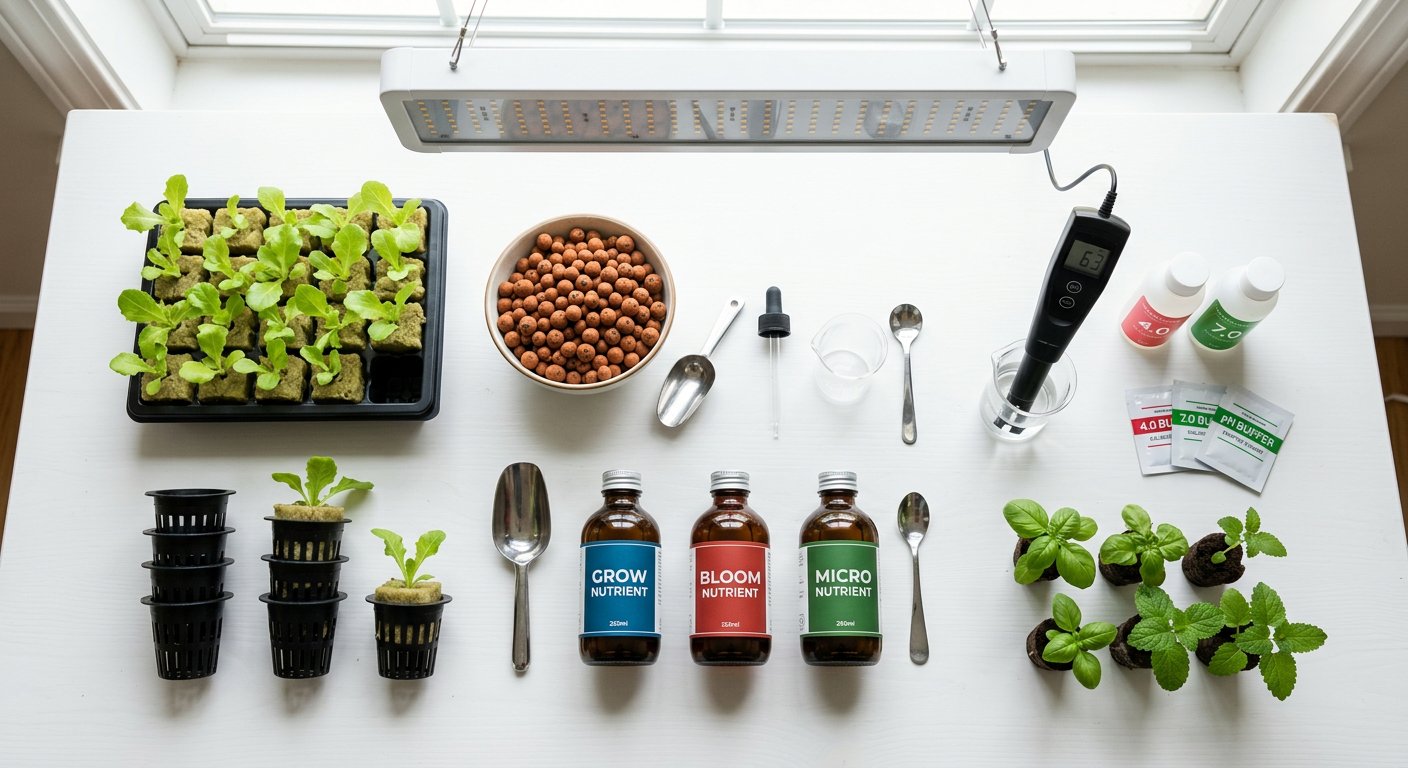
For a basic DWC setup, here's your shopping list:
- A food-grade plastic container or tote (10–20 gallon)
- Net pots (3" or 6" depending on your plants)
- Growing medium — clay pebbles (hydroton) work great
- An air pump and air stone (aquarium supplies)
- Hydroponic nutrient solution (start with a general-purpose formula like General Hydroponics FloraSeries)
- A pH testing kit or digital pH meter
- pH Up and pH Down solutions
- Seeds or seedlings
- Rockwool cubes for starting seeds
- A grow light if growing indoors (LED full-spectrum panels are excellent)
Your First Grow: Step by Step
Step 1: Germinate Your Seeds
Soak rockwool cubes in pH-adjusted water (5.5–6.0) for about an hour, then place 1–2 seeds in each cube. Keep them in a humidity dome under gentle light. Most seeds sprout within 3–7 days.
Step 2: Prepare Your Reservoir
Fill your container with water and add nutrients according to the manufacturer's instructions. For seedlings, start at ¼ to ½ strength. Stir well and check the pH — aim for 5.5–6.5 for most plants.
Step 3: Set Up Your System
Place the air stone in the reservoir and connect it to the air pump. Position your net pots in the lid so the bottom of the pots sit just at or slightly below the water line. Fill the net pots with clay pebbles and place your seedlings (still in rockwool) inside.
Step 4: Maintain and Monitor
Check the pH and water level every 2–3 days. Top up with fresh nutrient solution as needed. Every 2 weeks, completely change out the reservoir. Keep the water temperature between 18–22°C (65–72°F).
Step 5: Harvest!
Most leafy greens are ready to harvest in 3–5 weeks. You can do "cut and come again" harvesting with lettuce — cut the outer leaves and the plant keeps producing.
Common Beginner Mistakes to Avoid
- Ignoring pH: This is the #1 mistake. If pH is wrong, plants can't absorb nutrients even if they're present. Test regularly.
- Over-fertilizing: More nutrients ≠ faster growth. Start weak and increase gradually. You can always add more, but flushing out excess is harder.
- Skipping the air pump: Roots need oxygen. Without aeration, they'll drown and rot.
- Too much light for seedlings: Young plants need gentle light. Start with lower intensity and increase as they mature.
- Not cleaning the system: Algae and bacteria buildup can cause problems. Clean your reservoir thoroughly every 2 weeks.
What to Grow First
Start with plants that are forgiving and fast-growing:
- Lettuce — The absolute best beginner crop. Fast, forgiving, and delicious.
- Basil — Grows vigorously in hydroponics. Harvest regularly for bushier growth.
- Mint — Nearly impossible to kill. Spreads fast (which is actually a plus in a contained system).
- Spinach — Prefers cooler temperatures but grows quickly.
- Kale — Hardy, nutritious, and productive.
"The best time to start your first hydroponic garden was last year. The second best time is today. Start small, learn by doing, and you'll be amazed at what you can grow."
Next Steps
Once you've mastered leafy greens, you'll naturally want to expand. Tomatoes, peppers, cucumbers, and even strawberries are all achievable in hydroponics — they just need more space, stronger nutrients, and often pollination help. Check out our other guides on the best plants for hydroponics and choosing the right system to continue your journey.
Welcome to the world of hydroponics. Your plants (and your taste buds) will thank you. 🌱