Choosing your first hydroponic system can feel overwhelming. With so many methods available, how do you know which one is right for your space, budget, and goals? This detailed comparison breaks down the three most popular systems so you can make a confident decision.
Each of these three systems has been proven at both hobbyist and commercial scale. The "best" one depends entirely on what you want to grow, how much space and budget you have, and how much maintenance you're willing to do.
Deep Water Culture (DWC)
How It Works
Plants sit in net pots on a floating platform or lid, with roots dangling directly into a reservoir of nutrient solution. An air pump and air stone continuously oxygenate the water, keeping roots healthy and preventing stagnation. It's essentially a well-aerated nutrient bath.
Pros
- Simplest system to build and maintain — very few moving parts
- Cheapest to set up — a complete system can cost under $50
- Forgiving for beginners — large water volume buffers against pH/nutrient swings
- Excellent for leafy greens and herbs
- No pump failure risk (the air pump isn't critical for short periods)
- Very quiet operation
Cons
- Reservoir water heats up in warm environments — may need a chiller
- Not ideal for large, heavy fruiting plants (tomatoes need bigger setups)
- Each plant needs its own reservoir for true DWC, or you share one big one
- Root diseases can spread quickly if water gets contaminated
Best For
Beginners, small spaces, lettuce, herbs, and anyone wanting the simplest possible start. If this is your first system, DWC is almost certainly your best bet.
Estimated Cost
$30–$80 for a single-bucket system; $100–$250 for a multi-bucket recirculating setup.
Nutrient Film Technique (NFT)
How It Works
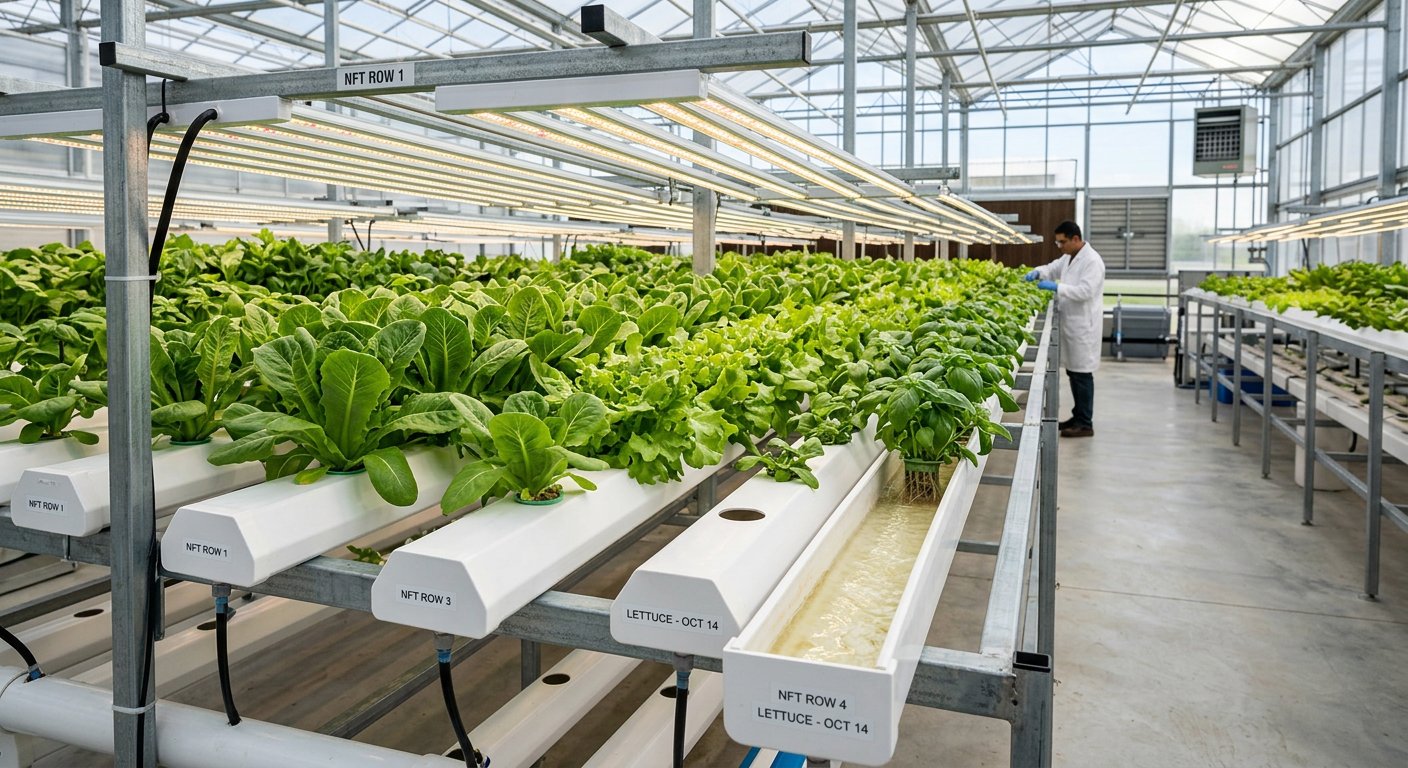
A pump pushes nutrient solution from a reservoir up to the high end of slightly sloped channels (usually PVC pipes or specialised NFT gullies). A thin film of solution flows along the bottom of the channel, bathing the roots, then drains back into the reservoir by gravity. Plants sit in net pots inserted into holes along the channel.
Pros
- Extremely water and nutrient efficient — thin film means minimal waste
- Excellent for commercial-scale growing — easily expandable
- Lightweight — channels hold very little water at any time
- Roots get maximum oxygen exposure — only the bottom sits in water
- Easy to inspect roots for health monitoring
Cons
- Very vulnerable to pump failure — roots dry out within hours if flow stops
- Channels can clog with root masses if plants grow too large
- Not suitable for heavy or tall plants — channels can't support much weight
- More complex to set up than DWC
- Temperature fluctuations affect the thin water film more quickly
Best For
Intermediate growers with a reliable power supply, commercial lettuce production, and anyone who wants maximum efficiency in a linear layout. Best for lightweight, fast-growing crops.
Estimated Cost
$80–$200 for a basic home setup; $300–$800 for larger multi-channel systems.
Ebb & Flow (Flood and Drain)
How It Works
A grow tray sits above a reservoir. On a timer, a pump floods the tray with nutrient solution to a set depth, soaking the growing medium and plant roots. After a set period (usually 15–30 minutes), the pump turns off and the solution drains back into the reservoir by gravity. This cycle repeats several times per day.
Pros
- Very versatile — works with almost any growing medium and plant type
- Good oxygenation — the drain cycle pulls fresh air into the root zone
- Can grow larger plants — the tray supports more weight than NFT channels
- Flood cycle flushes salts from the growing medium, preventing buildup
- Plants survive longer during pump failures — medium retains moisture
Cons
- Uses more growing medium (which is an ongoing cost)
- The pump and timer add complexity and potential failure points
- Medium can dry out between floods in hot conditions
- Algae can grow on the surface of exposed growing medium
- Heavier system — needs a sturdy stand
Best For
Growers who want versatility, anyone growing a mix of different plant types, and intermediate growers who want more control. Great for peppers, tomatoes, and larger herbs in clay pebbles or coco coir.
Estimated Cost
$60–$150 for a basic tray-and-reservoir setup; $200–$500 for larger or automated systems.
Head-to-Head Comparison
Beginner friendliness: DWC ⭐⭐⭐⭐⭐ | Ebb & Flow ⭐⭐⭐⭐ | NFT ⭐⭐⭐
Setup cost: DWC 💰 | Ebb & Flow 💰💰 | NFT 💰💰💰
Maintenance: DWC (Low) | NFT (Medium) | Ebb & Flow (Medium)
Water efficiency: NFT ⭐⭐⭐⭐⭐ | DWC ⭐⭐⭐⭐ | Ebb & Flow ⭐⭐⭐
Plant versatility: Ebb & Flow ⭐⭐⭐⭐⭐ | DWC ⭐⭐⭐ | NFT ⭐⭐
Failure tolerance: Ebb & Flow ⭐⭐⭐⭐⭐ | DWC ⭐⭐⭐⭐ | NFT ⭐⭐
So, Which Should You Choose?
Choose DWC if:
- You're a complete beginner
- You want to grow lettuce, herbs, or leafy greens
- Budget is a primary concern
- You want the simplest, most hands-off experience
Choose NFT if:
- You have some hydroponic experience
- You want to scale up production
- Space is limited but you want maximum plant count
- You can guarantee reliable power for the pump
Choose Ebb & Flow if:
- You want to grow a variety of different plants
- You're growing larger or fruiting plants
- You want a good balance of simplicity and versatility
- You don't mind managing growing medium
"There's no wrong answer here. All three systems produce amazing results when properly maintained. The best system is the one that matches your goals and lifestyle. Start with DWC if you're unsure — you can always add a different system later."
Remember: you don't have to commit to just one system forever. Many successful growers run multiple types — DWC for their daily salad greens, Ebb & Flow for peppers and tomatoes, and maybe a small NFT channel for herbs. Start simple, learn the fundamentals, and expand from there. 🌱