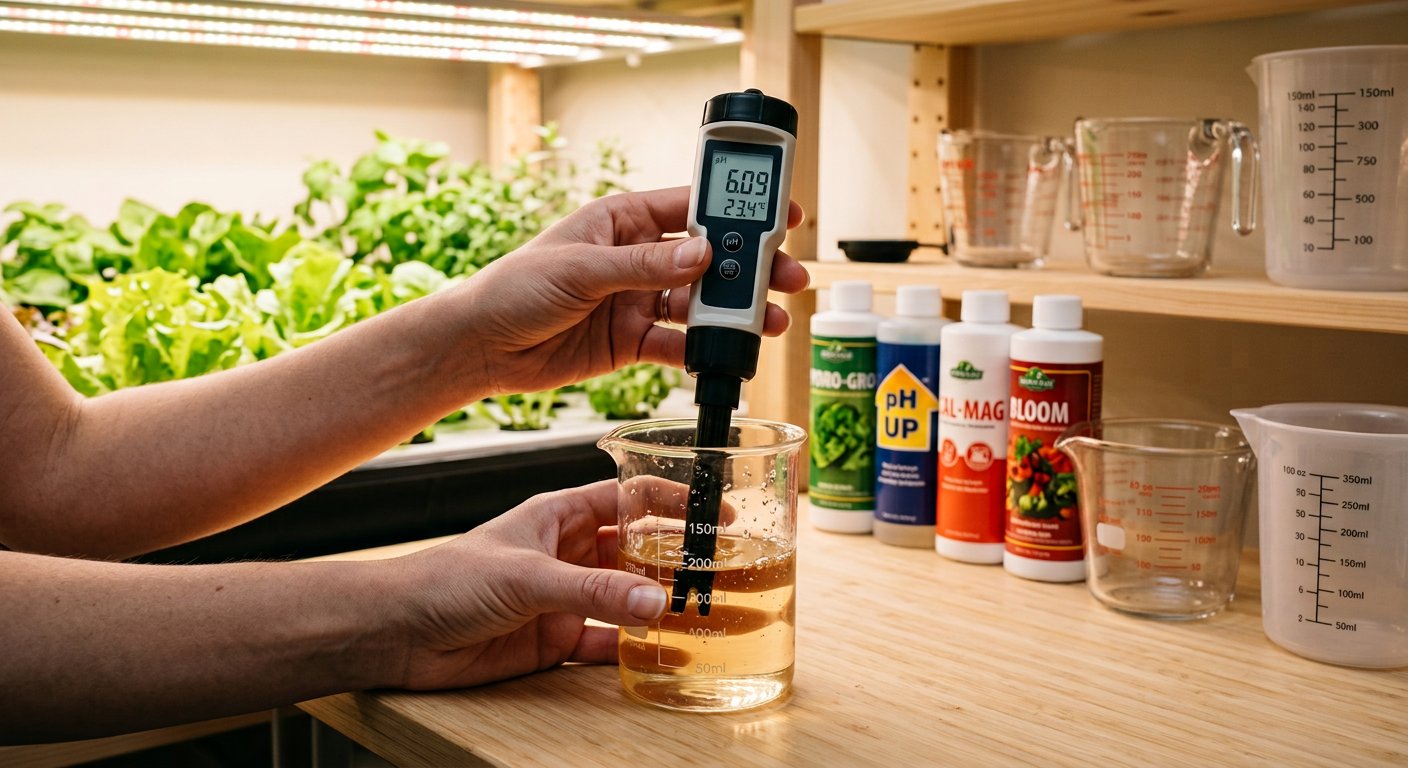
If pH and nutrient management had to be summarised in one sentence: get this right and your plants will thrive; get it wrong and nothing else matters. This guide demystifies the chemistry behind healthy hydroponic growth and gives you the practical knowledge to dial it in.
What Is pH and Why Does It Matter?
pH is a measure of how acidic or alkaline your nutrient solution is, on a scale from 0 (extremely acidic) to 14 (extremely alkaline), with 7.0 being neutral. In hydroponics, pH matters because it directly controls which nutrients your plants can actually absorb.
Even if your water contains all the right nutrients, if the pH is wrong, those nutrients become chemically "locked out" — present but unavailable. This is called nutrient lockout and it's one of the most common causes of deficiency symptoms in hydroponics.
The Sweet Spot
Most hydroponic plants thrive at a pH between 5.5 and 6.5. Within this range, all essential nutrients remain soluble and available for uptake. Different nutrients are optimally absorbed at slightly different pH levels, which is why a range (rather than a single number) is ideal.
- pH 5.5–6.0: Ideal for most leafy greens, herbs, and tomatoes
- pH 6.0–6.5: Better for peppers, cucumbers, and some fruiting plants
- pH below 5.0: Nutrient lockout of calcium, magnesium, and phosphorus
- pH above 7.0: Nutrient lockout of iron, manganese, zinc, and copper
The Essential Nutrients
Plants need 16 essential elements to grow. In hydroponics, you provide all of them through your nutrient solution (carbon, hydrogen, and oxygen come from air and water). Here's the breakdown:
Macronutrients (needed in large amounts)
- Nitrogen (N): Drives leaf and stem growth. The most important nutrient during vegetative growth. Deficiency shows as yellowing of older leaves.
- Phosphorus (P): Essential for root development, flowering, and fruiting. Deficiency shows as dark green or purplish leaves with slow growth.
- Potassium (K): Regulates water uptake, enzyme activation, and overall plant health. Deficiency shows as yellowing leaf edges and weak stems.
- Calcium (Ca): Critical for cell wall structure and root growth. Deficiency causes blossom end rot in tomatoes and tip burn in lettuce.
- Magnesium (Mg): The central atom in chlorophyll — essential for photosynthesis. Deficiency shows as yellowing between leaf veins on older leaves.
- Sulphur (S): Important for protein synthesis and enzyme function. Deficiency resembles nitrogen deficiency but appears on newer leaves first.
Micronutrients (needed in small amounts)
Iron, manganese, zinc, copper, boron, molybdenum, and chlorine. These are all included in quality hydroponic nutrient formulas — you rarely need to supplement them individually unless you notice specific deficiency symptoms.
Understanding NPK Ratios
Every hydroponic nutrient bottle displays three numbers — the NPK ratio (Nitrogen-Phosphorus-Potassium). These tell you the relative concentration of the three primary macronutrients:
- Vegetative growth (leafy greens, herbs): Higher nitrogen — look for something like 8-3-8 or use a "Grow" formula
- Flowering/fruiting (tomatoes, peppers): Higher phosphorus and potassium — look for something like 3-8-8 or a "Bloom" formula
- General purpose: Balanced ratios like 5-5-5 work well for mixed gardens
Most quality hydroponic nutrient lines come in 2-part or 3-part formulas (like General Hydroponics FloraSeries: FloraGro, FloraMicro, FloraBloom) that you mix in different ratios depending on the growth stage.
Measuring Nutrient Strength: EC and PPM
While pH tells you about nutrient availability, EC (Electrical Conductivity) or PPM (Parts Per Million) tells you about nutrient concentration — how much dissolved fertiliser is in your water.
How It Works
Dissolved nutrients conduct electricity. The more nutrients in solution, the higher the electrical conductivity. An EC meter measures this and gives you a number in mS/cm (millisiemens per centimetre). PPM is just EC multiplied by a conversion factor (usually 500 or 700 depending on the meter).
General EC Guidelines
- Seedlings/clones: 0.4–0.8 mS/cm (very light)
- Leafy greens: 0.8–1.2 mS/cm
- Herbs: 1.0–1.6 mS/cm
- Tomatoes/peppers (vegetative): 1.8–2.5 mS/cm
- Tomatoes/peppers (fruiting): 2.5–3.5 mS/cm
- Strawberries: 1.0–1.5 mS/cm
Always start at the lower end of the recommended EC range and increase gradually. It's much easier to add more nutrients than to flush out excess. If leaf tips start turning brown or curling, your EC is probably too high — dilute with fresh water immediately.
Your Testing and Adjustment Routine
Here's a simple routine that keeps most systems running smoothly:
- Test pH daily — Use a calibrated digital pH meter (more reliable than test strips). Dip the probe, read the number, rinse with distilled water.
- Test EC every 2–3 days — This tells you if your plants are drinking more water than nutrients (EC goes up) or more nutrients than water (EC goes down).
- Adjust pH as needed — Use pH Up (potassium hydroxide) to raise pH or pH Down (phosphoric acid) to lower it. Add a few drops at a time, stir, wait 5 minutes, and re-test.
- Top up water — As plants drink, the water level drops. Top up with pH-adjusted water and add nutrients proportionally.
- Full reservoir change every 2 weeks — Dump the old solution, rinse the reservoir, and mix fresh nutrients. This prevents salt buildup and nutrient imbalances.
Common pH Problems and Fixes
pH Keeps Drifting Up
This is normal in most hydroponic systems — plants uptake acidic ions, gradually raising pH. Causes include: too few plants for the reservoir size, hard tap water with high buffering capacity, or certain growing media like rockwool (which is naturally alkaline). Fix: Use pH Down as needed, or add a small amount of humic acid to help buffer the solution.
pH Drops Rapidly
This can indicate root rot (bacteria produce acids as they decompose dying roots), too-high nutrient concentration, or bacterial growth in the reservoir. Check roots for brown, slimy patches and a foul smell. Fix: Clean the system thoroughly, reduce nutrient strength, and add beneficial bacteria like Hydroguard.
Nutrients Cloudy or Smelly
Your reservoir has gone bad — usually from bacterial or algal growth. Fix: Dump it, scrub the reservoir with dilute hydrogen peroxide, rinse thoroughly, and mix fresh solution. Keep reservoirs covered (light promotes algae) and change water regularly.
Tools You'll Need
- Digital pH meter — Essential. Get one with automatic temperature compensation (ATC). The Apera PH20 is excellent for the price.
- EC/TDS meter — Measures nutrient strength. The HM COM-100 is a reliable, affordable option.
- pH Up and pH Down solutions — General Hydroponics or Masterblend are widely available and effective.
- Calibration solutions — pH 4.0 and 7.0 buffer solutions to calibrate your meter monthly.
- Measuring syringes or cups — For accurately dosing nutrients and pH adjusters.
"Think of pH as the gatekeeper and nutrients as the guests. If the gate (pH) is closed, it doesn't matter how many guests (nutrients) are waiting outside — none of them are getting in. Always check pH first when plants look unhealthy."
Final Thoughts
pH and nutrient management might seem like a lot of chemistry, but in practice it becomes second nature after your first few grows. Test daily, adjust as needed, change your reservoir every two weeks, and your plants will reward you with vigorous, healthy growth. Most problems in hydroponics trace back to pH or nutrient issues — master this and you've mastered 80% of the game. 🧪