Frequently Asked Questions
Your go-to source for unravelling the mysteries of soil-less gardening. From the basics to advanced tips, we've got answers to help your hydroponic journey thrive.
No matching questions found
Try a different search term or browse all categories above.
The Basics
Understanding what hydroponics is and why it works
What is hydroponic gardening?
Hydroponic gardening is a soil-less method of growing plants by using nutrient-rich water solutions instead of traditional soil. The plants' roots are supported by an inert medium like perlite, coconut coir, clay pebbles, or rockwool, which allows them to access the necessary nutrients, water, and oxygen directly.
Because nutrients are delivered straight to the roots in a readily available form, plants don't need to expend energy searching through soil — they can focus entirely on growing upward. This is why hydroponic plants typically grow 2–3× faster than their soil-grown counterparts.
What are the benefits and drawbacks of hydroponic gardening?
Benefits:
- Faster plant growth (2–3× faster than soil)
- Higher yields in less space
- Up to 90% less water usage through recirculation
- Precise control over nutrient levels and pH
- No weeds, fewer pests, and no soil-borne diseases
- Ability to grow year-round in any climate
- Perfect for small spaces, apartments, and urban areas
Drawbacks:
- Higher upfront costs for equipment and supplies
- Requires monitoring of pH, EC, and water levels
- Learning curve for beginners (but manageable!)
- Dependence on electricity for pumps and lights
- System failures (pump outages) need quick attention
Is hydroponics difficult for beginners?
Not at all! While hydroponics can seem intimidating at first, a basic Deep Water Culture (DWC) system is actually simpler to maintain than a traditional garden. You need to check pH every couple of days and change the water every two weeks — that's about it.
Start with easy crops like lettuce or basil, follow our Beginner's Guide, and you'll have your first harvest within 3–5 weeks. Most beginners find hydroponics addictive once they see how fast things grow!
How much does it cost to start a hydroponic garden?
You can build a fully functional DWC system for under $100 using a storage tote, air pump, net pots, clay pebbles, nutrients, and seeds. Our Budget Build Guide walks through a complete parts list with costs.
Ready-made kits typically range from $80–$300 depending on size and features. Ongoing costs are minimal — mainly nutrients ($10–20 every few months), growing media, and electricity for the air pump (roughly $1–2/month).
Systems & Setup
Choosing, building, and understanding hydroponic systems
What are the different types of hydroponic systems?
There are six main types of hydroponic systems:
- Deep Water Culture (DWC) — Plants float on oxygenated nutrient water. Simplest and best for beginners.
- Nutrient Film Technique (NFT) — A thin film of nutrients flows through sloped channels. Great for commercial lettuce production.
- Ebb & Flow (Flood and Drain) — Periodically floods and drains a grow tray. Very versatile.
- Aeroponics — Roots are misted with nutrients while suspended in air. Highly efficient but more complex.
- Drip Systems — Nutrients are dripped onto each plant's base. Common for larger plants like tomatoes.
- Wick Systems — A passive wick draws nutrients to the roots. No electricity needed, but limited output.
For beginners, we strongly recommend starting with DWC. Check out our detailed system comparison for a full breakdown.
What equipment do I need to start a hydroponic garden?
For a basic DWC setup, you'll need:
- A food-grade container or storage tote (10–20 gallon)
- Net pots (3-inch for most plants)
- Growing medium (clay pebbles or rockwool)
- Air pump + air stone + tubing
- Hydroponic nutrient solution (3-part formula like FloraSeries)
- pH testing kit and pH Up/Down solutions
- Seeds or seedlings
If growing indoors, you'll also need a grow light (LED full-spectrum panels are excellent) and optionally a timer to automate the light cycle. See our budget build guide for a complete parts list with prices.
Do I need grow lights, or can I use sunlight?
You can absolutely use sunlight! If you have a spot that receives 6+ hours of direct sunlight daily (a sunny windowsill, balcony, or greenhouse), many plants like lettuce and herbs will grow just fine.
However, for consistent, year-round results — especially for fruiting plants like tomatoes — a grow light gives you much more control. LED grow panels (60–100W) cost $30–50 and can cover a small system. They use very little electricity (about $3–5/month) and let you grow anywhere: basements, closets, or spare rooms.
How much space do I need for a hydroponic garden?
Surprisingly little! A basic DWC bucket takes up about a 40cm × 40cm footprint. You can grow 4–6 lettuce plants in that space. Vertical NFT systems and stackable towers can produce impressive amounts in even smaller areas.
Many apartment dwellers successfully grow herbs and salad greens on a kitchen bench or windowsill. The beauty of hydroponics is that it scales from a single mason jar with a basil plant all the way up to commercial vertical farms.
Plants & Growing
What to grow, how to grow it, and when to harvest
Can I grow any plant in a hydroponic system?
While many plants can thrive in hydroponic systems, some are far more suitable than others. The best performers include:
- Leafy greens: Lettuce, spinach, kale, arugula, Swiss chard
- Herbs: Basil, mint, cilantro, parsley, oregano, thyme
- Fruiting crops: Tomatoes, peppers, cucumbers, strawberries
- Fast crops: Microgreens, sprouts
Plants with deep tap roots (carrots, parsnips), large spreading plants (corn, pumpkins), and perennial trees are much more challenging and generally not practical for most home hydroponic setups.
Check out our guide on the 7 best plants for hydroponics for detailed growing specs.
How fast do plants grow in hydroponics compared to soil?
Most plants grow 2–3× faster in hydroponics than in soil. For example:
- Lettuce: 5–6 weeks in soil → 3–4 weeks hydroponically
- Basil: 8–10 weeks in soil → 4–6 weeks hydroponically
- Tomatoes: 80–90 days in soil → 60–70 days hydroponically
The speed increase comes from direct nutrient delivery (no root searching), optimal oxygen levels at the roots, and controlled environmental conditions. You'll genuinely be amazed the first time you see the difference.
What is the best pH range for hydroponic plants?
Most hydroponic plants thrive at a pH between 5.5 and 6.5. Within this range, all essential nutrients remain soluble and available for uptake.
If pH drifts outside this range, certain nutrients become "locked out" — present in the water but chemically unavailable to the plant. This is the #1 cause of nutrient deficiency symptoms in hydroponics.
Test your pH every 2–3 days with a digital meter or test kit, and adjust with pH Up or pH Down solutions as needed. Our pH and Nutrients Guide covers this in detail.
How do I start seeds for hydroponics?
The most common method is using rockwool starter cubes:
- Soak rockwool cubes in pH-adjusted water (5.5–6.0) for 30 minutes
- Place 2–3 seeds in each cube's pre-drilled hole
- Put cubes in a tray with 1cm of water and cover with a humidity dome
- Place under gentle light or on a sunny windowsill
- Seeds typically sprout in 3–7 days
- Transplant into your system once the first true leaves appear (7–14 days)
Alternatives to rockwool include coco coir plugs, Oasis cubes, and rapid rooter plugs. All work well — rockwool is just the most widely available and affordable.
Maintenance & Troubleshooting
Keeping your system healthy and solving common problems
How do I maintain my hydroponic garden?
Regular maintenance is straightforward and only takes a few minutes:
- Daily (1 min): Check that the air pump is running. Quick visual check of your plants.
- Every 2–3 days (5 min): Test pH and adjust if outside 5.5–6.5. Top up water if the level has dropped. Add nutrients when topping up more than 25%.
- Every 2 weeks (15 min): Full reservoir change — drain, rinse, and refill with fresh nutrient solution. Check roots for health (should be white/cream, not brown/slimy).
You'll also need to clean and sanitise your system periodically to prevent algae, bacteria, and fungi growth. A dilute hydrogen peroxide rinse works well between cycles.
How do I troubleshoot common issues in hydroponic gardening?
Here are the most common issues and their fixes:
- Yellowing leaves: Usually a pH imbalance or nutrient deficiency. Check pH first (should be 5.5–6.5). If pH is fine, check EC — you may need stronger nutrients.
- Brown, slimy roots: Root rot caused by low oxygen or bacterial infection. Increase air pump output, lower water temperature below 24°C, and add beneficial bacteria (Hydroguard).
- Algae growth: Light is reaching your nutrient solution. Cover the reservoir and wrap any clear tubing. A small amount on the surface is usually harmless.
- Wilting plants: Check water level (may be too low), air pump (may have failed), or water temperature (too warm reduces dissolved oxygen).
- Brown leaf tips: Nutrient concentration too high (EC is elevated). Dilute with fresh water immediately.
- Slow growth: Check light intensity/duration, nutrient strength, pH, and water temperature. One of these is almost always sub-optimal.
The key principle: always check pH first. Most apparent nutrient deficiencies are actually pH lockout issues.
How often should I change the nutrient solution?
For most home systems, a full reservoir change every 2 weeks is ideal. This prevents salt buildup, nutrient imbalances, and bacterial growth.
Between changes, top up with pH-adjusted water and add nutrients proportionally as the level drops. If you notice your EC creeping up despite topping up with water, it's time for a full change — salt accumulation is occurring.
When changing: drain the old solution (it makes great fertiliser for outdoor plants!), rinse the reservoir with water, and mix a fresh batch of nutrients.
What should the water temperature be?
The ideal reservoir water temperature is 18–22°C (65–72°F). This range holds enough dissolved oxygen for healthy root growth.
When water exceeds 24°C (75°F), dissolved oxygen drops significantly, increasing the risk of root rot. In warm climates or during summer, you may need to: keep the reservoir in shade, add frozen water bottles, use a water chiller, or insulate the container.
Below 15°C (59°F), nutrient uptake slows and plant growth can stall. In cool environments, a simple aquarium heater set to 20°C works well.
Sustainability & Urban Farming
Hydroponics and its role in sustainable, future-facing agriculture
What is the environmental impact of hydroponic gardening?
Hydroponic gardening can have significant positive environmental impacts:
- Water savings: Uses up to 90% less water than traditional agriculture through recirculation
- Reduced pesticide use: Indoor, controlled environments drastically reduce pest pressure
- Less land use: Vertical stacking and denser planting produce more food per square metre
- Reduced food miles: Grow food where people live, eliminating transport emissions
- No soil erosion: Eliminates one of the biggest environmental costs of traditional farming
- No fertiliser runoff: Closed-loop systems prevent nutrient pollution of waterways
The main environmental consideration is electricity use for grow lights and pumps, but this is increasingly offset by renewable energy sources and the dramatic efficiency of modern LED lighting.
How does hydroponics fit into sustainable and urban farming?
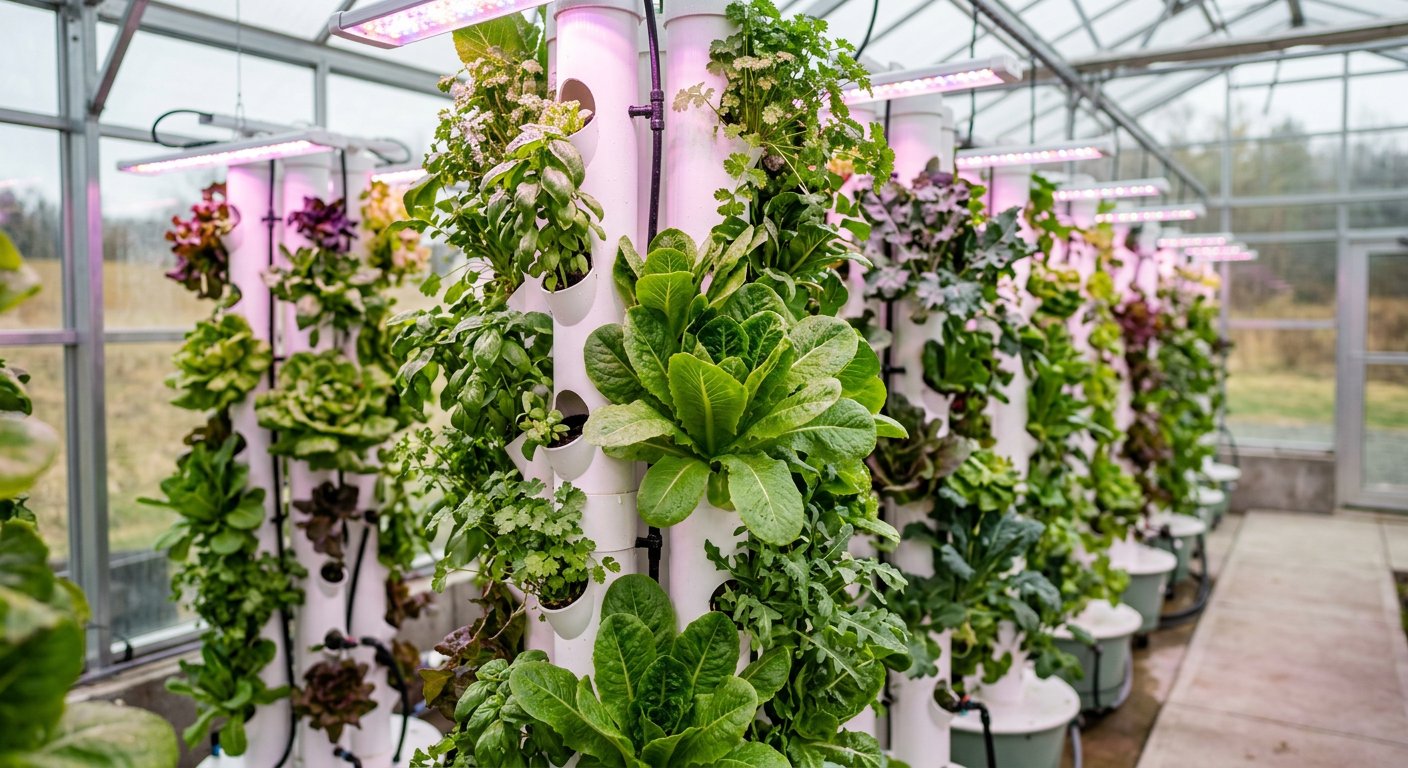
Hydroponics is exceptionally well-suited for sustainable and urban farming due to its efficient use of resources and adaptability to small or unconventional spaces.
By growing plants in vertical farms, rooftops, shipping containers, or urban gardens, hydroponics can help address food security and accessibility issues while reducing the environmental footprint of traditional agriculture. Cities around the world are already adopting hydroponic systems to produce fresh food locally — from Singapore's vertical farms to New York's rooftop greenhouses.
On a personal level, even a small home hydroponic garden reduces your food miles, packaging waste, and exposure to pesticides. Every lettuce you grow at home is one that didn't need to be transported, packaged, and refrigerated from a distant farm.
Is hydroponic produce organic?
This is a topic of ongoing debate. In most countries (including the US and New Zealand), hydroponic produce can be certified organic if you use approved organic nutrient sources. However, some organic certification bodies argue that "organic" should require soil.
In practice, hydroponically grown produce is often cleaner than conventionally grown organic produce — no pesticides, no herbicides, and complete control over what touches your food. Many growers use organic nutrient lines or supplement with compost teas for a more natural approach.
Regardless of the label, home-grown hydroponic produce is about as fresh, clean, and transparent as food gets.
Still Have Questions?
We're here to help. Reach out to our team or browse our blog for in-depth guides on every aspect of hydroponic growing.
Browse Our Blog →